

Eagle Badger
ECOWAS Stability Index
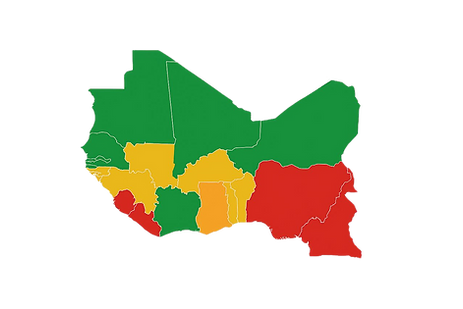
About the Stability Index
The Eagle Badger Stability Index is a proprietary tool that measures political, economic, social, and environmental stability across ECOWAS nations. Using advanced data analytics and real-time data collection, our index provides actionable insights for governments, businesses, and organizations operating in West Africa.
Updated quarterly, the Stability Index incorporates 16 different indicators across four key dimensions, with statistically optimized weights based on historical data analysis:
-
Social Stability: Global Terrorism Index, Internally Displaced Persons, Crime Rate, Literacy Rate
-
Economic Stability: GDP Growth Rate, Inflation, Moody's Credit Rating, Unemployment Rate, Income Inequality
-
Political Stability: Corruption Perception, Political Freedom, Democratic Continuity, Number of Protests
-
Environmental Stability: Pandemic & Disease Impact, Floods & Natural Disasters
Methodological Note: Countries that have experienced a coup or violent revolution leading to government change in the last 5 years (Mali, Burkina Faso, Guinea, Niger) used to receive a political freedom score of zero. However in the updated methodology we replaced binary coup penalties with Graduated Instability Multiplier that applies time-based decay penalties eliminating any bias from the system.
Stability Score Interpretation:
Stable
Moderate Risk
High Risk
Score Range: 0-100, where higher scores indicate greater stability
Data Source: Analysis based on World Bank, Transparency International, Global Terrorism Database, ILO, Internal Displacement Monitoring Centre (IDMC), WHO Global Health Observatory, and EM-DAT International Disaster Database, ACLED
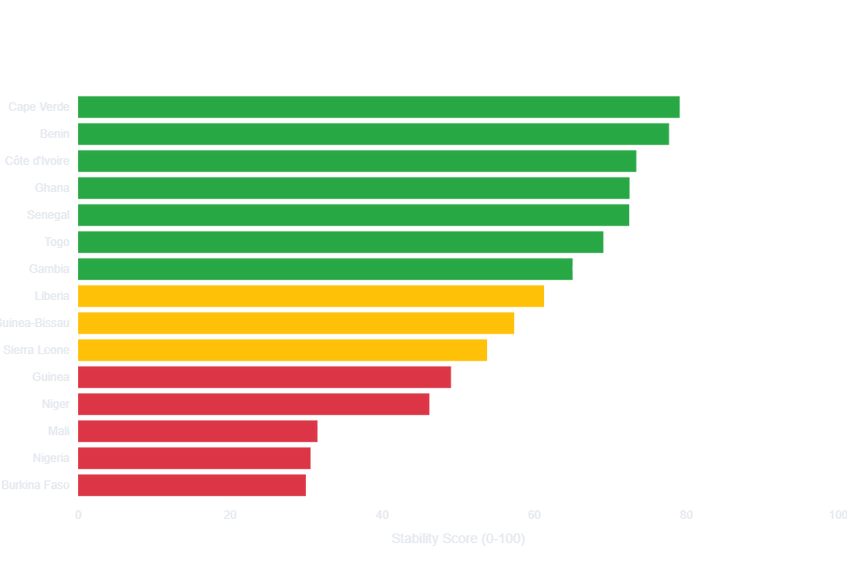
Overall Stability Ranking Q1 2026
.png)
ECOWAS Stability Trend Analysis
.png)
Access the Full ECOWAS Stability Index
Our complete stability analysis includes detailed reports on all 16 statistically optimized indicators across the ECOWAS region, with correlation analysis, historical data tracking, customized risk assessments, and quarterly forecasts.
Key Features:
Statistical Weights
Rigorous correlation analysis with stability outcomes (2015-2023)
Enhanced Environment
Data
WHO and EM-DAT verified pandemic and disaster metrics
Political Coup
Adjustment
Replaced binary coup penalties with Graduated Instability Multiplier.